
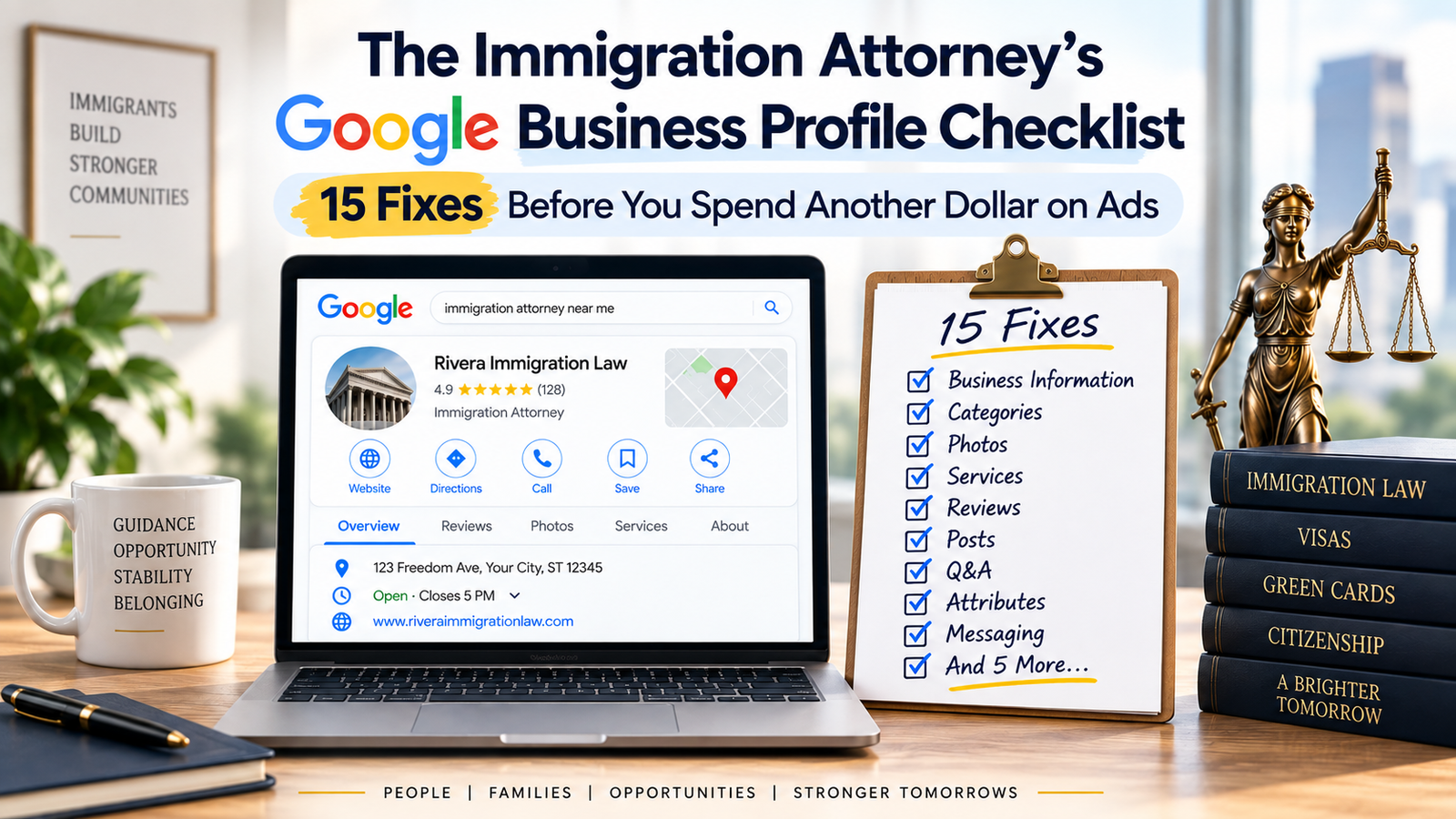
The Immigration Attorney's Google Business Profile Checklist: 15 Fixes Before You Spend Another Dollar on Ads
 Yemi Oyedepo
·
Published September 18, 2026
·
8 min read
Yemi Oyedepo
·
Published September 18, 2026
·
8 min read
Short answer: most immigration law firms lose local visibility to fixable Google Business Profile errors, not to competitors with bigger budgets. This checklist covers all 15 fixes across profile accuracy, content and activity, reviews and reputation, and technical verification, so you can correct what's broken before spending on paid ads to compensate for it.
A Google Business Profile is the single highest-leverage local SEO asset an immigration law firm controls, and it's also the one most often left half-finished. Firms invest in content, links, and paid campaigns while their profile sits with an outdated address, a generic category, or reviews no one has responded to in a year. Before adding to a marketing budget, it's worth confirming the free asset is actually optimized. This checklist walks through all 15 fixes, grouped the way a firm should actually work through them: a complete local SEO playbook for immigration law firms covers the broader strategy this checklist supports.
Key takeaways
- A wrong primary category or mismatched business name can quietly disqualify a firm from map pack rankings, no matter how much content or link building happens elsewhere.
- Reviews, photos, and Google Posts are ranking and conversion signals, not vanity metrics; profiles that go quiet for months lose ground to competitors who stay active.
- Running ads to compensate for a broken or thin Google Business Profile treats the symptom. Fixing the profile first typically lowers cost per lead once ads do run.
- Multi-attorney and multi-office firms carry extra risk: duplicate listings, inconsistent NAP data, and unmanaged profile access are common and often go unnoticed for years.
Getting the foundation right
Is the primary category set to the most specific option available?
"Immigration Attorney" should be the primary category whenever it's available in a firm's country and region, rather than a broader label like "Law Firm" or "Legal Services." Google weighs primary category heavily in local ranking, and a vague category makes it harder to surface for immigration-specific searches even when the rest of the profile is strong.
Does the business name on the profile match the name on the firm's signage and website exactly?
Google's guidelines require the listed name to match how the business presents itself in the real world, without added keywords like "Best Immigration Lawyer" stuffed into the name field. A mismatch between the profile name and the name on the website, signage, or filed business registration is one of the more common triggers for a suspended or demoted listing.
Is the address formatted consistently, including suite or floor numbers?
An address that reads "Suite 400" on the website and "Ste 4" or "4th Floor" on the Google profile creates the kind of inconsistency that erodes trust signals across citation sources. The address format on the Google Business Profile should match the format used everywhere else the firm is listed, down to abbreviations and punctuation.
Are service areas configured correctly for firms that serve clients beyond their office location?
Immigration firms frequently take clients from outside their immediate metro area, and Google's service-area settings let a profile reflect that without misrepresenting the office's physical location. Firms that skip this setting, or that try to list a virtual address as a second office, risk both lost visibility in the areas they actually serve and policy violations tied to fake locations.
Keeping the profile active and specific
Does the business description name specific practice areas instead of staying generic?
A description that says "full-service immigration law firm helping clients since 2010" gives Google and prospective clients little to work with. Naming the actual practice areas, such as family-based petitions, employment visas, or removal defense, gives the profile more relevant terms to match against searches and helps a searcher self-select faster.
Have new photos been added within the last 90 days?
Profiles with stale photo libraries, often just a logo and an old exterior shot, signal inactivity. Adding current photos of the office, attorneys, and team on a regular cadence keeps the profile looking active and gives Google fresher content to index alongside the listing.
Is someone publishing Google Posts on a consistent schedule?
Google Posts function similarly to short social updates directly on the profile, covering policy changes, upcoming webinars, or reminders about filing deadlines. Firms that post at least twice a month tend to maintain more visible, more frequently refreshed profiles than firms that posted once at setup and never returned.
Is anyone monitoring and answering the Questions & Answers section?
The Q&A feature on Google Business Profiles is public and editable by anyone, which means unanswered or inaccurate questions can sit visible to every future searcher. A firm that checks this section regularly can seed it with accurate, useful answers to common questions before a stranger's guess becomes the top-voted response.
Building visible proof of client outcomes
Does the firm have a compliant, repeatable process for requesting reviews?
A consistent review request process, sent at a specific point after a case milestone, produces steadier review volume than asking occasionally when someone remembers. The request language should stay factual and avoid anything that could be read as pressuring a specific rating, both for compliance and because reviews that feel coached read as less credible to future clients.
How quickly does the firm respond to new reviews, positive and negative?
Responding within a few days, rather than weeks or not at all, signals an actively managed profile to both prospective clients and to Google. Negative reviews in particular benefit from a prompt, professional response, since the response is often read by more people than the original review.
Has the firm checked for duplicate or outdated listings under a previous name or address?
Firms that rebranded, moved offices, or merged practices often have an old, forgotten listing still live and competing with the current one for the same searches. Duplicate listings split review counts and confuse Google's understanding of which profile is authoritative, and should be merged or closed as soon as they're found.
Is review velocity steady, or did it spike once and then go quiet?
A burst of reviews followed by months of silence looks different to both Google and to a searcher scrolling review dates than a steady trickle over time. Firms with an ongoing request process tend to maintain more consistent velocity, which supports both trust and ranking more reliably than a single push for reviews.
None of these twelve items require legal expertise to fix, just consistent attention. The remaining three are less about day-to-day upkeep and more about protecting the profile from problems that are harder to undo once they happen.
Protecting the profile long-term
Does more than one person at the firm have verified access to manage the profile?
A profile tied to a single departed employee's personal Google account is a common and preventable failure point. Adding at least one additional owner or manager, ideally a role-based account the firm controls directly, protects against losing access entirely if one person leaves or becomes unreachable.
Has the firm weighed a paid directory listing against the SEO return it's likely to produce?
Legal directories vary widely in how much local SEO value they actually pass along versus how much they simply charge for placement, and weighing SEO investment against paid directory listings before renewing or adding one keeps a firm's citation budget pointed at sources that move the needle rather than ones that just look credible.
Is the profile's name, address, and phone number consistent across every major directory?
Inconsistent NAP data across a firm's website, Google profile, and third-party directories weakens the trust signals search engines use to confirm a business is legitimate and accurately located. Google's own guidelines on representing a business accurately lay out exactly what needs to match, and a periodic audit against those guidelines catches drift before it affects rankings.
Not sure which of these 15 items are already broken?
A Google Business Profile audit takes less time than one paid ad campaign, and it's usually the faster path to more calls from qualified clients.
Frequently asked questions
How often should an immigration law firm update its Google Business Profile?
Photos and Google Posts should be updated at least monthly, while core details like category, address, and service areas should be checked quarterly or any time the firm changes locations, rebrands, or adds a new practice area.
Can a wrong category really affect map pack rankings that much?
Yes. Primary category is one of the strongest signals Google uses to match a business to a local search, so a generic category like "Law Firm" instead of "Immigration Attorney" can meaningfully reduce visibility for immigration-specific searches even when every other ranking factor is strong.
Should a firm run Google Ads before or after fixing its Business Profile?
Fixing the profile first is usually the better sequence, since a broken or thin profile undercuts the credibility and click-through rate of paid ads pointing to it. Firms that fix the profile first often see a lower cost per lead once ads do launch.
What's the fastest way to check if a firm has a duplicate Google Business Profile?
Searching the firm's name along with its city on Google, and checking Google Maps directly for the same search, will usually surface a duplicate if one exists. Any past address or previous business name should be searched separately as well, since duplicates often carry outdated information.
Do multi-attorney firms need more than one person managing the Google Business Profile?
Yes. Having at least one backup manager or owner on the profile, tied to a role-based account rather than one individual's personal login, protects against losing access if that person leaves the firm.
Yemi Oyedepo
Works with immigration law firms on local and organic search strategy, including Google Business Profile optimization, content, and technical SEO built around how prospective clients actually search. Has led local, bilingual, and content SEO programs for 30+ immigration firms nationwide, with an average 4.9-star client rating. See the full results. More about our team and approach →
This content is for general informational purposes and does not constitute legal or marketing advice specific to any firm. Individual results vary based on market, competition, and execution. Attorney advertising rules vary by state; firms should confirm compliance with their state bar's advertising rules (see ABA Model Rules 7.1-7.4 as a general reference point) before publishing client results or testimonials.