
Case Study: How an Asylum & Removal Defense Firm Grew Organic Traffic from 380 to 1,400 Sessions a Month
 Yemi Oyedepo
·
Published October 30, 2026
·
6 min read
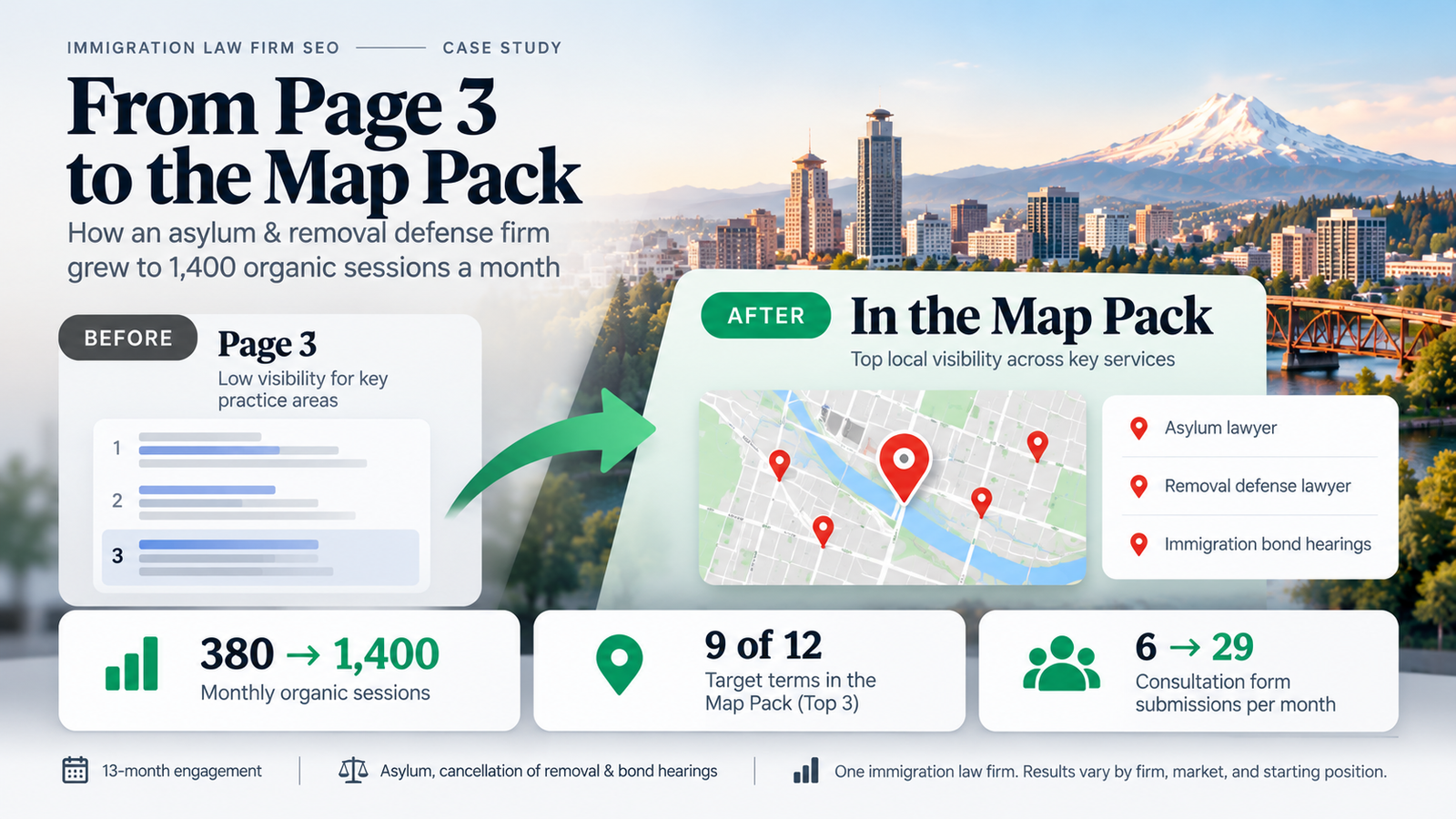
Short answer: Over a 13-month engagement, a four-attorney asylum and removal defense firm's monthly organic sessions rose from 380 to 1,400. Nine of twelve tracked target terms reached the top three of the Map Pack, and monthly consultation form submissions rose from six to 29. This is one engagement, not a forecast.
A traffic number on its own tells you very little. Fourteen hundred visits from the wrong searches is just a bigger report. What makes this engagement worth examining is that organic traffic, Map Pack visibility, and consultation form submissions all moved, and that the firm's work was specific enough to explain why.
This is a case study of immigration law firm organic traffic growth for one practice, and I've kept two things apart: what was documented, and what I think it means. The client isn't named. The figures match the case study on our results page.
Key takeaways
- The firm started on page three for removal-defense searches, with thin generic content and a Business Profile flagged for incomplete service categories.
- The work had three parts: rebuilt practice pages, Spanish and Amharic pages, and a rebuilt Business Profile with FAQ content.
- Over 13 months, sessions rose from 380 to 1,400 and form submissions from six to 29 a month.
- The workstreams ran together, so this case doesn't isolate which one mattered most or prove a formula.
The result in brief
| Measure | Result |
|---|---|
| Monthly organic sessions | 380 to 1,400 |
| Tracked target terms in the Map Pack's top three | 9 of 12 |
| Monthly consultation form submissions | 6 to 29 |
| Engagement length | 13 months |
Each measure answers a different question. Google defines a session as a period of time during which a user interacts with your website or app, so organic sessions count visits that arrived from unpaid search. Map Pack position shows local visibility for a set of tracked searches. A consultation form submission is an inquiry. It is not a retained case, and this case study doesn't measure what happened after the form.
The starting point: page three wasn't enough
The firm is a four-attorney boutique in the Portland metro area. It focuses on asylum, cancellation of removal, and bond hearings. Those are matters where the person searching is often under real pressure and wants to find a specific kind of help quickly.
Three problems stood out:
- The firm ranked on page three across removal-defense searches.
- Its website content was thin and generic.
- Its Google Business Profile was flagged for incomplete service categories.
My read. Each problem has a practical consequence, though I wouldn't claim any single one explains the results. Few people scroll to page three. A page that says "we handle immigration matters" can't compete for a search about bond hearings. And a profile with missing categories gives Google less to match against what the searcher wants.
The strategy: make the firm's actual expertise discoverable
The work followed the firm's real practice rather than a generic checklist. It had three parts.
1. Rebuild the practice pages
The asylum, cancellation of removal, and bond hearing pages were rebuilt with carefully reviewed, accurate content. The goal was for each page to have one clear job: explain one kind of case, who it's for, and how a first conversation with the firm begins. In immigration law an inaccurate page does more harm than a thin one, so accuracy review came before publishing.
2. Add Spanish and Amharic pages
The firm added pages in Spanish and Amharic to reflect the people it actually serves. That decision came from the client base, not from keyword volume. Language pages only make sense when the firm can genuinely serve people in that language, and adding them doesn't guarantee a ranking.
3. Rebuild the Business Profile and add FAQ content
The Google Business Profile was rebuilt, and FAQ content was added to answer relevant, time-sensitive questions. Google's guidance is to pick a specific primary category and add up to nine more where they fit, so completeness matters, but accuracy matters more. Our Google Business Profile checklist for immigration attorneys covers the fields to review, and our guide to local SEO for immigration law firms explains how the profile and the website work together.
What the numbers do and don't show
Sessions rose about 3.7 times over 13 months, and form submissions rose from six to 29 a month. Nine of the twelve target terms reached the top three of the Map Pack. Those are the documented outcomes.
Here is what they don't show. The three workstreams ran together, so I can't tell you how much each one contributed. SEO also builds over months, so a 13-month result says little about what a firm should expect in month three. And a rise in form submissions says nothing about how many became retained cases, which depends on the firm's intake and capacity.
That caution is part of the point. A case study should help you judge whether the approach makes sense for your firm. It shouldn't set an expectation of the same numbers.
Why the approach made sense
The firm needed three things, and each workstream met one of them. The practice pages gave it specific coverage of what it actually does. The Business Profile gave it an accurate local presence. The language pages and FAQ content spoke to the questions and languages of its clients.
This is what we mean by Qualified Visibility: being easier to find for the searches that match the work a firm wants. It also explains why the profile, the site content, and the technical foundations are best planned together, which is the idea behind our full-service SEO for immigration law firms. For a different practice area and a different local market, see another immigration firm's local SEO case study.
What can another immigration firm learn from this?
You don't need to hire anyone to use the sequence:
- Decide which practice areas you actually want to grow.
- Compare your current visibility with the searches relevant to those services.
- Inspect the quality and specificity of your existing pages before commissioning new ones.
- Review your Business Profile for accuracy and completeness.
- Measure inquiries and consultations alongside traffic.
The right priorities depend on your market, your site, your competitors, and your capacity to handle new inquiries. See more immigration law firm SEO results for context across practice areas.
Want to see where your firm stands?
We'll look at your current visibility, the competitive landscape, and the clearest opportunities we see.
Frequently asked questions
How much did the firm's organic traffic grow?
Monthly organic sessions rose from 380 to 1,400 over a 13-month engagement. Nine of twelve tracked target terms also reached the top three of the Map Pack.
How long did the results take?
The engagement ran 13 months. There is no standard timeline for SEO, and this result shouldn't be read as a prediction for another firm.
Will my immigration firm get the same results?
Not necessarily. Results depend on your starting position, market, competition, existing website, and intake capacity. This case study describes one engagement.
Does more organic traffic mean more clients?
Not by itself. Traffic is useful evidence, but its value depends on relevance and on how the firm handles inquiries. In this case, consultation form submissions rose from six to 29 a month, and those are inquiries, not retained cases.
Yemi Oyedepo
Works with immigration law firms on local SEO, website content, and search strategy. Has led local, bilingual, and content SEO programs for 30+ immigration firms nationwide, with an average 4.9-star client rating. See the full results. More about our team and approach →
Immigration Lawyer SEO Expert is a marketing consultancy and does not provide legal services or legal advice. This case study describes one client engagement; results vary and past results do not guarantee future outcomes. The client is not named. Platform guidance changes often. We last reviewed the sources cited here on October 29, 2026, and will review this case study again by July 2027.