
Immigration Lawyer SEO vs. Google & Meta Ads: Where Slower USCIS Timelines Change the Math in 2026
 Yemi Oyedepo
·
Published September 25, 2026
·
9 min read
Short answer: for most immigration law firms, SEO delivers stronger long-term return than Google or Meta ads, and that gap has widened as USCIS processing times stretch the client decision window out for months. Paid search still earns its keep for urgent, high-intent categories, but a compounding organic presence beats rented ad space once a firm's typical case timeline runs past a few months.
Every immigration firm eventually asks some version of the same question: should the next marketing dollar go into SEO or into ads? For years the honest answer was "it depends," and it still is, but one of the biggest variables in that equation has shifted hard in 2026. USCIS processing times have stretched dramatically, and that single change reshapes how quickly a paid click needs to convert into revenue to justify its cost, and how much runway an organic strategy has to compound before it needs to prove itself.
Key takeaways
- USCIS's average backlog clearance time nearly doubled year over year, from 9.4 months to 18.6 months, which extends the window a firm has to earn a client's trust before a decision is made.
- Google and Meta ads still win on speed and control, especially for narrow, high-intent searches tied to a specific visa category or deadline.
- SEO's cost per lead tends to fall over time as content and authority compound, while PPC's cost per lead stays roughly flat, or rises, for as long as the campaign runs.
- The firms getting the best return in 2026 aren't choosing one channel exclusively. They're using PPC to cover urgent, narrow intent and SEO to own the researching, comparison-shopping majority of their prospective clients.
Why the SEO vs. PPC calculus is changing in 2026
Processing delays used to be a client-experience problem. Now they're also a marketing-math problem. According to the American Immigration Council's analysis of USCIS filing data, the agency's pending caseload grew from 9.7 million to 11.3 million applications between the first quarter of FY2025 and the first quarter of FY2026, a 16.5% increase, while average backlog clearance time nearly doubled, from 9.4 months to 18.6 months over the same period.
That matters for a simple reason: a longer average case timeline means a longer average window between when a prospective client starts researching and when they actually retain a firm. A paid click that doesn't convert within days or weeks of the campaign running is a click a firm paid for and got nothing back on. An organic result that a prospective client finds during month one of a five-month research process, and returns to repeatedly before finally calling, costs the firm nothing per visit after the content is built.
What PPC is actually good at for immigration firms
None of this makes paid search useless. Google and Meta ads remain the fastest way to put a firm in front of someone who is searching right now, with clear intent, for something narrow: a same-week consultation, a specific visa category with a filing deadline attached, a firm in a specific city. PPC also gives a level of control organic content never will, since a firm can turn a campaign on, adjust the offer, and see results within days rather than months.
Per 2026 legal-industry Google Ads benchmarks, the average cost per click for legal services keywords runs roughly $8.58, with a typical cost per lead north of $130, and that's before accounting for the roughly one-third of legal ad spend the same benchmarks attribute to poorly targeted keywords. Those numbers are workable for a firm with a defined, high-value case type and a tight geographic radius. They get harder to justify at scale, especially when a meaningful share of that traffic represents someone still months away from actually retaining anyone.
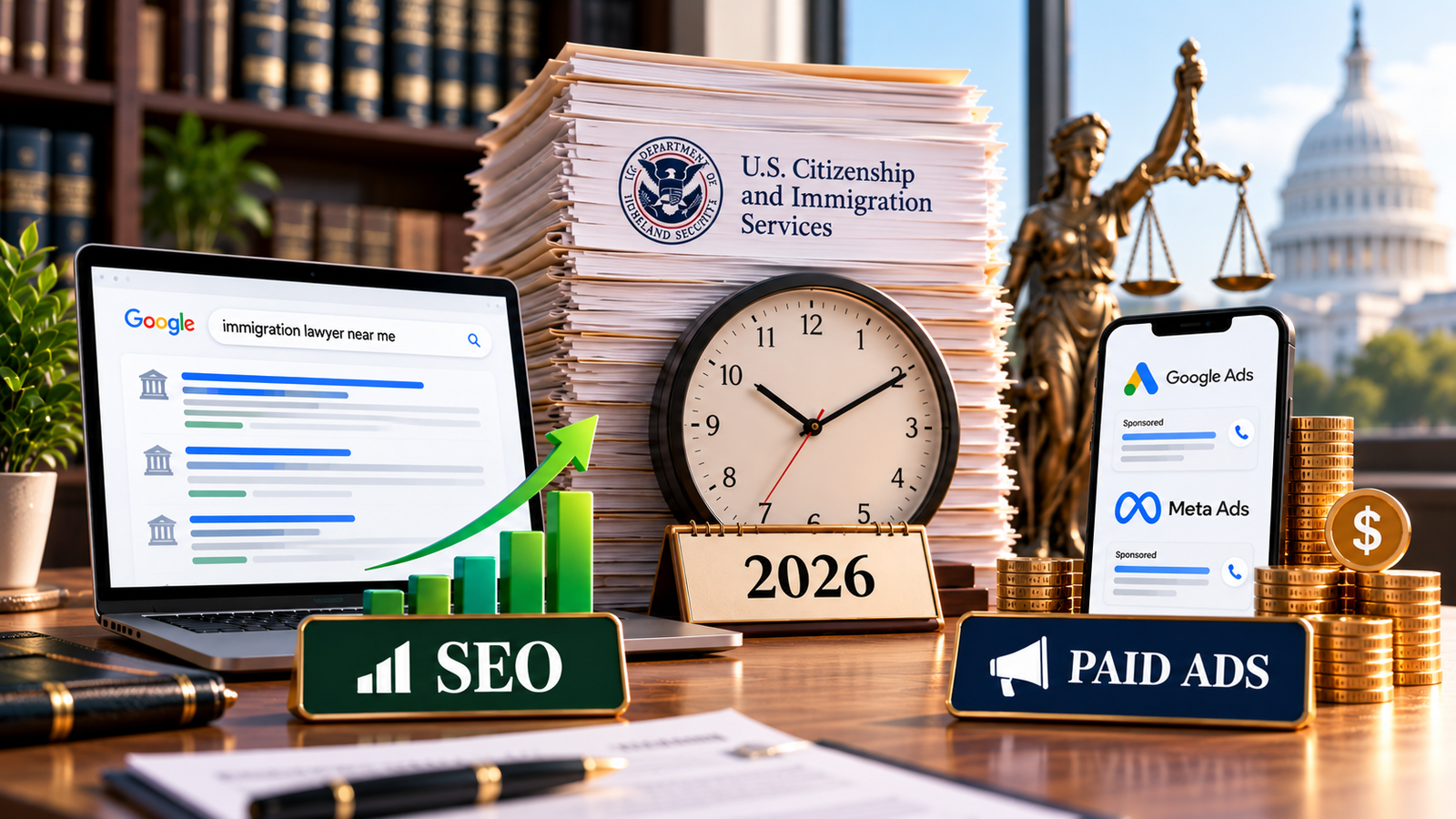
SEO vs. PPC, side by side
Where SEO wins
- Cost per lead trends down over time as content and authority build.
- Visible throughout a multi-month research and comparison window, not just at the moment of a click.
- Compounds: a page built once keeps earning visits for years with modest upkeep.
- Builds durable trust signals (reviews, citations, expert content) that also support paid campaigns.
Where PPC wins
- Immediate visibility, often within a day of launching a campaign.
- Precise targeting by keyword, geography, and urgency.
- Easy to pause, scale, or redirect around a filing deadline or policy change.
- Useful for testing which offers and messages actually convert before investing in content.
Why longer case timelines favor SEO's compounding curve
The core economic difference between the two channels is what happens to cost per lead as time passes. A PPC campaign's cost per lead stays roughly flat for as long as the campaign runs, since every click is paid for individually regardless of whether that visitor converts today or in eight months. An SEO program's cost per lead tends to fall over time, since a page that ranks well keeps generating visits without an additional per-click charge, and a firm's overall content library keeps compounding as more pages rank for more of the searches a prospective client runs during a long research process.
A five-to-eighteen-month case timeline means a prospective client might search for an immigration attorney, read about their specific visa category, compare a few firms, and return to a firm's site more than once before ever filling out a contact form. Every one of those repeat visits is free if the firm found them through organic search, and repeated if the firm is paying per click.
What this means for pricing conversations with a firm's marketing budget
Firms weighing this tradeoff often want to see the actual math laid out against their own budget rather than industry averages, since the right split depends heavily on practice mix, case value, and how competitive a given metro area is. For firms working through that exercise, a breakdown of immigration SEO pricing and expected ROI walks through how to model the comparison against a firm's specific numbers rather than general benchmarks.
The same discipline applies to comparing SEO against other channels beyond paid ads. Before renewing or adding a paid legal directory listing, weighing SEO investment against paid directory listings is worth doing for the same reason: both compete for the same marketing dollar, and both should be judged against what they actually return, not what they cost to maintain.
A practical framework: when PPC still makes sense
The choice isn't binary for most firms. A reasonable framework looks like this:
- Use PPC for narrow, high-intent, time-sensitive searches, a specific visa category with a filing deadline, a same-week consultation request, or testing a new practice area's messaging before committing content budget to it.
- Use SEO as the default for anything with a multi-month research and decision window, which describes most immigration case types given current processing timelines.
- Run both together where budget allows, since a strong organic presence typically lowers the cost of paid campaigns too, by improving quality score and giving searchers a firm they've already seen before they click an ad.
A full SEO program built around a firm's actual case mix and service areas is usually the higher-leverage long-term investment, with PPC layered in selectively rather than treated as the default channel.
How to tell which channel is actually working
Most firms track leads by channel but stop short of tracking what those leads actually cost once a longer case timeline is factored in. Two comparisons matter more than raw lead count:
- Cost per retained client, not just cost per lead. PPC often produces more raw form fills, but a meaningful share of paid traffic represents early-stage research rather than someone ready to retain. Tracking which channel's leads actually convert to signed clients, not just submitted forms, usually tells a very different story than lead volume alone.
- Trend direction over a full quarter, not a single month. SEO's value shows up as a downward trend in cost per lead over several months as content matures. A single month of data will always make PPC look more immediately productive, since that's the nature of a channel that's paid for per click rather than built once.
Firms that only look at last month's lead count tend to overweight PPC and underweight SEO, simply because SEO's return shows up on a longer timeline that matches, not coincidentally, the same longer timeline USCIS processing delays are now creating on the client side.
Not sure how your current channel mix stacks up?
Get a clear, numbers-based read on where your marketing budget is working hardest, and where it isn't.
Frequently asked questions
Should a new immigration firm start with SEO or PPC?
A new firm with no existing search visibility often benefits from starting with PPC to generate leads immediately while an SEO program builds, then shifting budget toward SEO as organic rankings mature, typically over 6 to 12 months.
How much does Google Ads cost for immigration law firms?
Legal services keywords average roughly $8.58 per click industry-wide, with cost per lead frequently exceeding $130, though costs vary significantly by city and by how competitive the specific keyword or visa category is.
Does a longer USCIS backlog actually change which channel performs better?
Yes, indirectly. A longer average case timeline extends the research and comparison window before a prospective client retains a firm, which favors channels like SEO that stay visible throughout that window at no additional per-visit cost, over channels like PPC where every visit is paid for individually.
Can SEO and PPC run at the same time without competing for the same budget?
Yes, and for many firms that's the strongest setup. SEO handles the compounding, multi-month research window, while PPC covers narrow, urgent searches that need to convert immediately, and the two channels often reinforce each other's performance.
Yemi Oyedepo
Works with immigration law firms on channel strategy and budget allocation across SEO and paid search, alongside local and content SEO execution. Has led local, bilingual, and content SEO programs for 30+ immigration firms nationwide, with an average 4.9-star client rating. See the full results. More about our team and approach →
Immigration Lawyer SEO Expert is a marketing consultancy and does not provide legal services or legal advice. USCIS processing times and advertising cost benchmarks change over time; figures above reflect the most recent published data as of this post's publication date and should be reverified before relying on them for budget decisions. Individual results vary by market, competition, and execution.