
The State of Immigration Law Firm Marketing in 2026: What's Changing and Why It Matters
 Yemi Oyedepo
·
Published August 28, 2026
·
8 min read
Yemi Oyedepo
·
Published August 28, 2026
·
8 min read
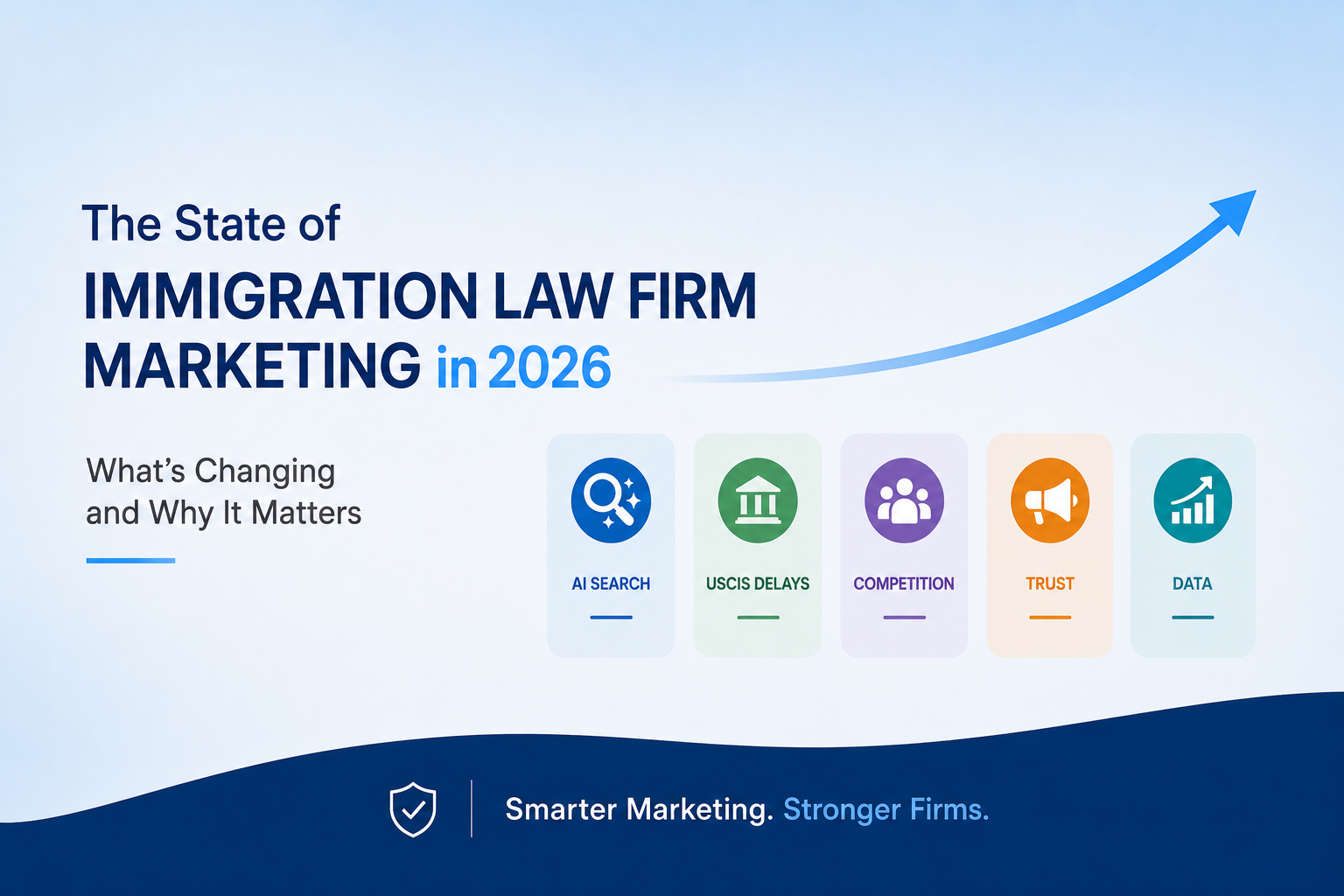
Short answer: immigration law firm marketing in 2026 is being reshaped by five forces at once: AI-mediated search, unpredictable USCIS-driven demand spikes, rising competition for the same keywords, a bigger share of search happening in Spanish, and trust signals mattering more than raw rankings. Firms adapting to all five are pulling ahead of firms still running a 2022-style playbook.
Every few years, "what's working in legal marketing" shifts enough that last year's playbook stops paying off. 2026 is one of those years for immigration law. The channels haven't changed. Search is still where most prospective clients start. What has changed is how search itself works, how often demand spikes without warning, and how crowded the immigration keyword space has become.
None of this is a reason to panic. It's a reason to know what's actually shifting before you plan next quarter's marketing budget. Here are the five changes worth understanding, in plain terms, with what each one means for a firm that wants to keep showing up where its next client is looking.
Key takeaways
- A large share of searches now end without a click, and a meaningful portion of legal searches surface an AI Overview before a firm's own website ever appears.
- USCIS policy changes and fee updates create short, sharp spikes in search demand that a fixed monthly content calendar usually misses.
- More firms are investing in immigration SEO, which means broad terms are getting crowded and visa-category specificity matters more than it used to.
- A growing share of the immigration audience searches in Spanish first, not as a fallback from English.
- Both Google and AI answer engines are weighting trust signals, like named authorship, reviews, and case results, more heavily than rankings alone.
Five things reshaping immigration law firm marketing this year
1Search is becoming a zero-click, AI-mediated experience
Most searches for an immigration lawyer no longer end in a click. Early 2026 data shows roughly two-thirds of US Google searches ending without anyone clicking a result at all, and AI Overviews now surface on a meaningful share of legal and government-related searches. For an immigration firm, that means showing up inside an AI-generated answer is starting to matter as much as ranking on the page below it.
A large-sample analysis of legal search results found AI Overviews triggering on roughly a quarter of legal queries, and these systems tend to pull from third-party sources, government sites, and legal directories rather than a firm's own homepage. That shifts the goal from "rank first" to "be the source an AI system trusts enough to cite," which rewards firms publishing clear, well-sourced, regularly updated content over firms simply chasing keyword volume.
2USCIS policy volatility is creating unpredictable search spikes
A single USCIS rule change, fee update, or court ruling can shift search volume for an entire visa category within days. Firms publishing on a fixed monthly calendar consistently miss the window when demand, and search interest, is highest.
The 2025 to 2026 stretch has been a clear example, with a wave of policy shifts including steep increases to H-1B consular processing fees and adjustment-of-status changes generating sudden jumps in search interest around those specific terms. A firm that already has an H-1B page live, and can update it within hours of a policy announcement, captures search demand that a firm starting from scratch simply cannot reach in time.
3More firms are competing for the same immigration keywords
Immigration is no longer an underserved niche in search. More firms are investing in SEO every year, which means broad terms that used to be easy wins, like "immigration lawyer near me", are getting crowded fast.
The firms pulling ahead aren't outspending the competition. They're targeting the 40-plus visa-category and case-type searches that most competitors still fold into one generic page. We covered why that specificity matters in more detail in niche immigration SEO vs generalist law firm SEO, but the short version is that broad-keyword competition rewards firms with the narrowest, most specific content, not the biggest budget.
4Bilingual search is no longer optional
A growing share of the immigration audience searches in Spanish first, not as a fallback from English. "Abogado de inmigración" is a distinct search with its own intent, not a translation of "immigration lawyer."
Firms still treating Spanish content as an afterthought, or worse, a machine-translated copy of their English pages, are leaving a lower-competition, high-intent segment of search almost entirely to whichever competitor built for it directly. This is one of the fastest, most underused wins available to a firm that hasn't invested in it yet.
5Trust signals are doing more work than rankings alone
Ranking well is no longer enough on its own. Google's own quality guidelines, and the AI systems increasingly sitting in front of search results, are weighting demonstrated experience, named authorship, and third-party validation more heavily before treating a page as trustworthy enough to surface or cite.
In practice, that means real attorney bios instead of generic "our team" pages, genuine client reviews instead of stock testimonials, and case results presented with real numbers instead of vague claims. A page can rank on technical merit alone. Getting cited, recommended, or trusted at the moment a prospective client is deciding who to call takes more than that.
Roughly how much more often AI Overviews cite pages that carry named authorship, sourced statistics, and a visible update date, compared to unattributed, undated content, based on generative-engine-optimization research. Structure and trust signals now matter as much as raw content volume.
The firms pulling ahead in 2026 aren't publishing more. They're publishing content built to be found by a person, an algorithm, and an AI model at the same time.
What this means for your firm's marketing
None of these five shifts require throwing out what's already working. They require aiming it more precisely. A firm running a full SEO program built around visa-category pages, bilingual content, policy monitoring, and verified authorship is already positioned for all five trends at once, because they were never separate problems to begin with. They're five symptoms of the same underlying shift: search has gotten more specific, more automated, and less forgiving of generic content.
We'll go deeper on the AI and answer-engine piece specifically in an upcoming post on getting cited by AI search tools. For now, the practical starting point is simple: audit what you're currently publishing against these five forces, and be honest about which ones your firm is actually built for and which ones are still a gap.
See where your firm stands against these five trends
Book a free 30-minute audit and get a clear read on where your current marketing is keeping pace, and where it isn't.
Frequently asked questions
Do these trends apply to small and solo immigration practices, or only larger firms?
They apply across the board. Search behavior shifts for everyone searching, regardless of firm size. A solo practice with a handful of well-built visa-category pages and real client reviews is often better positioned than a larger firm still running generic, templated content.
Which of these five trends should a firm address first?
It depends on the firm's current gaps, but bilingual search and visa-category specificity tend to be the fastest wins since they're within a firm's direct control. AI-search visibility and trust signals usually take longer to build and compound over time.
How often should a firm revisit its marketing strategy given how fast this is changing?
A full strategy review once or twice a year is reasonable, but content tied to USCIS policy should be reviewed as news breaks, not on a fixed schedule. The gap between a policy change and a firm's content catching up to it is exactly where competitors gain ground.
Yemi Oyedepo
SEO Strategist at Immigration Lawyer SEO Expert, working exclusively with immigration law firms. Has led local, bilingual, and content SEO programs for 30+ immigration firms nationwide, with an average 4.9-star client rating. See the full results. More about our team and approach →
Immigration Lawyer SEO Expert is a marketing consultancy and does not provide legal services or legal advice. Search data and trend figures cited above reflect industry research current as of publication and are subject to change.