
Why a Niche Immigration Lawyer SEO Agency Beats a Generalist Legal SEO Firm
 Yemi Oyedepo
·
Published August 21, 2026
·
8 min read
Yemi Oyedepo
·
Published August 21, 2026
·
8 min read
Short answer: yes, for most immigration law firms, a niche SEO agency outperforms a generalist one. Immigration search behavior is specific: visa-category intent, bilingual queries, USCIS policy swings, and strict bar advertising rules. A specialist builds around all four from day one. A generalist treats "immigration lawyer" like any other legal keyword and misses most of it.
If you've talked to more than one SEO agency, you've probably heard some version of the same pitch: "We do SEO for lawyers." Personal injury, family law, criminal defense, immigration: same process, same deliverables, same monthly report. On paper it sounds efficient. In practice, it's the reason so many immigration firms spend a year on SEO and can't point to a single case type where it moved the needle.
Immigration law isn't one practice area searched one way. It's a dozen practice areas: H-1B sponsorship, family-based petitions, asylum, EB-5 investment, naturalization, removal defense, each with its own search intent, its own seasonality, and often its own language. A generalist agency's playbook wasn't built to see that. Here's what actually changes when the agency behind your SEO only works with immigration firms.
Key takeaways
- Generalist legal SEO agencies typically target "immigration lawyer" as a single keyword instead of the 40+ visa-category and case-type intents that actually drive search volume.
- A niche agency builds separate landing pages per visa category and case type, because that's how people actually search.
- Bilingual SEO only works when Spanish content is built from independent keyword research, not translated from English pages.
- Immigration is one of the few practice areas where policy news (USCIS rule changes, fee updates, court rulings) creates predictable, trackable spikes in search demand.
- Every claim on an immigration firm's site carries bar-advertising risk (most states base their rules on ABA Model Rules 7.1–7.4, with state-specific variations), and an agency that doesn't specialize in legal marketing may not catch it.
What "generalist legal SEO" actually looks like on an immigration site
Most legal SEO agencies aren't immigration specialists. They're generalists who happen to serve law firms. That distinction matters more than it sounds. A generalist agency's process is built to scale across every practice area they sell to, which means the immigration playbook usually looks like this:
- One keyword, not forty. "Immigration lawyer [city]" gets the SEO budget. H-1B, EB-5, asylum, naturalization, and removal defense (each searched differently, by different people, at different points in the legal process) get folded into one generic practice-area page.
- Templated landing pages. The same page structure the agency uses for a personal injury client gets reused for an immigration client, with the nouns swapped out.
- No policy calendar. USCIS fee changes, new visa rules, and court decisions create real, trackable search spikes. A generalist agency has no reason to watch for them.
- Generic, risk-prone copy. "We win cases" or "guaranteed results" reads fine to an agency that doesn't know bar advertising rules. To most state bars, it's a compliance problem waiting to happen. More on that below.
- Spanish as an afterthought. If bilingual content exists at all, it's often a direct translation of the English page rather than content built around how people actually search in Spanish.
None of this means generalist agencies are bad at SEO. It means their system was built for breadth, not for the specific shape of immigration-law search demand, and immigration has a shape all its own.
The cost of that gap shows up in the data. Firms with a regularly updated blog generate roughly 3.4x more leads than firms without one, according to legal-marketing benchmarking research, and a SearchMetrics review found only about 12% of law firm websites correctly implement legal schema markup, meaning most sites, generalist-run or not, are leaving basic structured-data visibility unclaimed. A niche agency that's already fluent in visa-category content and legal schema starts several steps ahead of that baseline, whether the work is scoped as local, website, or full SEO.
Where niche expertise actually shows up in your numbers
This is the part that's easy to claim and hard to prove, so here's what it looks like in practice rather than in theory.
Visa-category pages instead of one generic practice page
Someone searching "H-1B lawyer" and someone searching "family-based green card attorney" are at different points in different processes, with different urgency and different budgets. A niche approach builds a dedicated page for each visa category and case type your firm actually handles: H-1B and employment-based visas, family-based petitions, asylum and removal defense, EB-5 investor visas, naturalization, so each page can rank for, and speak directly to, that specific search. The same logic applies locally: a Google Business Profile optimized for "H-1B attorney near me" outperforms one written for "immigration lawyer" in general.
Bilingual SEO built as its own strategy, not a translation pass
"Abogado de inmigración" isn't the Spanish version of "immigration lawyer." It's a different search, often made by a different person, at a different stage of the decision. Spanish-language pages need their own keyword research and their own content, not a machine-translated copy of the English site. For many immigration practices, this single change opens up lower-competition keywords that a generalist agency never even builds toward.
Content that's timed to policy, not just published on a schedule
Immigration is one of the few legal niches where a single policy announcement (a new USCIS fee, a rule change, a high-profile court ruling) can shift search volume within days. An agency that watches immigration policy specifically can get relevant content live while demand is spiking. A generalist agency, publishing on a generic content calendar, usually catches the story after the search volume has already peaked. This is one of several forces reshaping the space right now; see our broader look at immigration law firm marketing trends in 2026 for the full picture.
Copy that's checked against advertising rules, not just grammar
Every claim about outcomes, every testimonial, every "specialist" label on an immigration firm's site carries bar-discipline risk. Most states base their attorney advertising rules on the ABA Model Rules of Professional Conduct, generally 7.1 through 7.4, though the specifics vary by state, so this isn't a substitute for checking your own bar's current rules. A niche legal-SEO agency builds a compliance review into its content process as a matter of course. A generalist content team, focused on conversion copywriting, may not know the rules exist at all.
One client's monthly organic sessions after a year on visa-category and policy-timed content, up from roughly 200. A single result, not a guarantee, but representative of the pattern above. See the full breakdown on our results page →
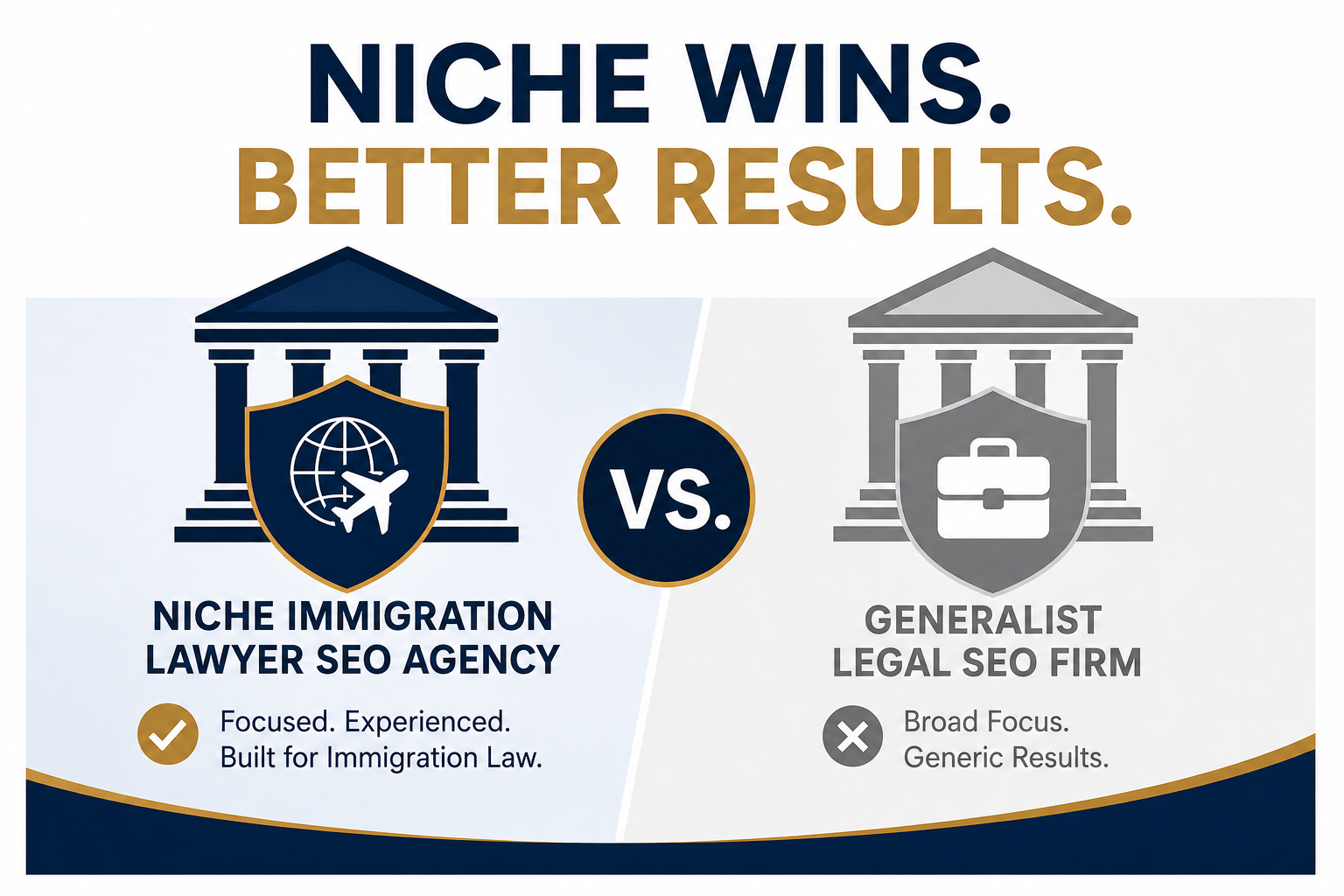
Niche agency vs. generalist agency, side by side
A generalist legal SEO agency
- Treats "immigration lawyer" as one keyword, not 40+ visa-category intents
- Reuses the same landing-page template across every industry they serve
- Doesn't track USCIS policy changes that shift what people search
- Writes generic "we get results" copy that risks bar ad-rule violations
- Ignores that a large share of your leads search in Spanish
A niche immigration SEO agency
- Builds separate landing pages for H-1B, EB-5, asylum, family-based, and removal defense
- Writes content specifically for each visa category and case type
- Monitors policy shifts and updates content before search demand spikes
- Reviews every claim for bar-advertising compliance
- Builds English and Spanish content as two distinct strategies
A generalist agency asks "what SEO template do we already have?" A niche agency asks "how does someone searching for an asylum attorney actually search?"
Six questions to ask before you hire an SEO agency for your immigration practice
You don't need to take an agency's word for whether they're actually specialized. Ask these directly during the sales call:
- Can you show me visa-category or case-type pages you've built for other immigration clients? Not a generic practice-area page: an actual H-1B, asylum, or EB-5 page.
- How do you track immigration policy news, and does it change your content calendar? A real answer includes a process, not just "we stay informed."
- Is your Spanish content translated, or built from separate keyword research? Translation and bilingual SEO are not the same service.
- How do you review copy against bar advertising rules? There should be an actual step in their process, not a vague assurance.
- What do you report on: rankings, or consultations booked? Rankings are an input. Consultations booked is the output that actually funds your firm, and that matters more than it sounds: Clio's legal marketing research found roughly one in four law firms has no reliable way to track how a lead reached them in the first place.
- Do you work with other immigration firms in my market? If so, ask how they handle exclusivity. Competing against your own agency's other client is a real risk in a niche this small.
What this costs versus what it's worth
Niche agencies aren't automatically more expensive than generalists, but they're rarely the cheapest option either, because the work is genuinely more specific: 40+ landing pages instead of one, ongoing policy monitoring, a second content strategy for Spanish search, and a compliance review layer most generalist teams skip entirely. The honest way to evaluate the cost isn't against a generalist's rate card. It's against what a single missed visa-category page or a single ad-rule complaint actually costs your firm. No reputable agency can promise page-one rankings or guaranteed results; anyone who does is already telling you something about how carefully they read the advertising rules that apply to your business.
The bottom line
A generalist legal SEO agency isn't going to sink your firm's marketing. But if your firm handles multiple visa categories, serves Spanish-speaking clients, and operates in a niche where policy news moves search demand overnight, a generalist's one-size-fits-all playbook is going to leave a lot of that opportunity on the table. A niche agency's entire system, from keyword research to compliance review, is built around the fact that immigration law isn't "law" in general. It's a dozen different practices wearing one label.
See where your firm stands
Book a free 30-minute audit and get a clear read on your current visa-category and local visibility. No generic template involved.
Frequently asked questions
Is niche immigration SEO more expensive than generalist legal SEO?
Not inherently. Pricing depends on scope, not on niche-versus-generalist status. A niche agency's retainer often covers more ground (visa-category pages, policy monitoring, a separate bilingual strategy) than a generalist's, so like-for-like line items are hard to compare directly. Most niche agencies confirm exact scope and pricing after a free audit rather than quoting blind.
Can a generalist agency still get results for an immigration firm?
Yes, particularly for firms with a single, narrow focus (for example, only family-based petitions in one city). The gap widens as a firm's practice areas, languages, and markets multiply. That's where a generalist's one-template approach starts missing search volume a specialist would capture.
How long before switching to a niche agency shows results?
Most firms see local visibility gains within 60–90 days, with compounding growth over 6–12 months as visa-category pages and bilingual content mature. Timelines vary by market competition and starting point. Any agency promising a guaranteed date should be treated with caution.
Yemi Oyedepo
SEO Strategist at Immigration Lawyer SEO Expert, working exclusively with immigration law firms. Has led local, bilingual, and content SEO programs for 30+ immigration firms nationwide, with an average 4.9-star client rating. See the full results. More about our team and approach →
Immigration Lawyer SEO Expert is a marketing consultancy and does not provide legal services or legal advice. Results vary by firm, market, and starting point; no SEO agency can ethically guarantee rankings or case outcomes.