
AI Search Visibility for Immigration Lawyers: How to Get Cited by AI
 Yemi Oyedepo
·
Published October 13, 2026
·
18 min read
Short answer: Law firms get cited in AI answers the way they earn visibility in regular search. Important pages are crawlable, indexed, and eligible to show a snippet; they answer real client questions accurately; and they show verifiable attorney expertise. No technique guarantees a citation on Google, ChatGPT, or Perplexity.
Over the past year, the most common question I've heard from immigration firm owners has changed. It used to be "why aren't we on page one?" Now it's "why doesn't ChatGPT mention us?"
The honest answer is usually less exotic than people expect. Most firms that are invisible in AI answers have the same problems they had in regular search, and the fix starts in the same place.
Key takeaways
- There's no separate AI playbook. Google, OpenAI, and Perplexity all point back to crawlable, indexable, genuinely useful pages.
- Check access first. A blocked crawler, a CDN rule, or a leftover snippet setting can quietly remove you from AI answers.
- Immigration content carries extra risk. Outdated fees, forms, or eligibility details can be summarized out of context, so accuracy and review dates matter more here.
- Citations aren't the goal. Qualified consultations are, so measure the whole path rather than appearances alone.
What Is AI Search Visibility for Law Firms?
AI search visibility is a law firm's ability to be discovered, referenced, or linked when people use AI-powered search tools to research legal questions, compare providers, or explore their options.
Traditional search shows a list of webpages. AI-powered search may summarize information from several sources and link to the pages that support the answer. Google says its AI Overviews and AI Mode may use a "query fan-out" technique, running several related searches behind the scenes. That means a firm can show up for a question it never targeted directly.
Someone might ask:
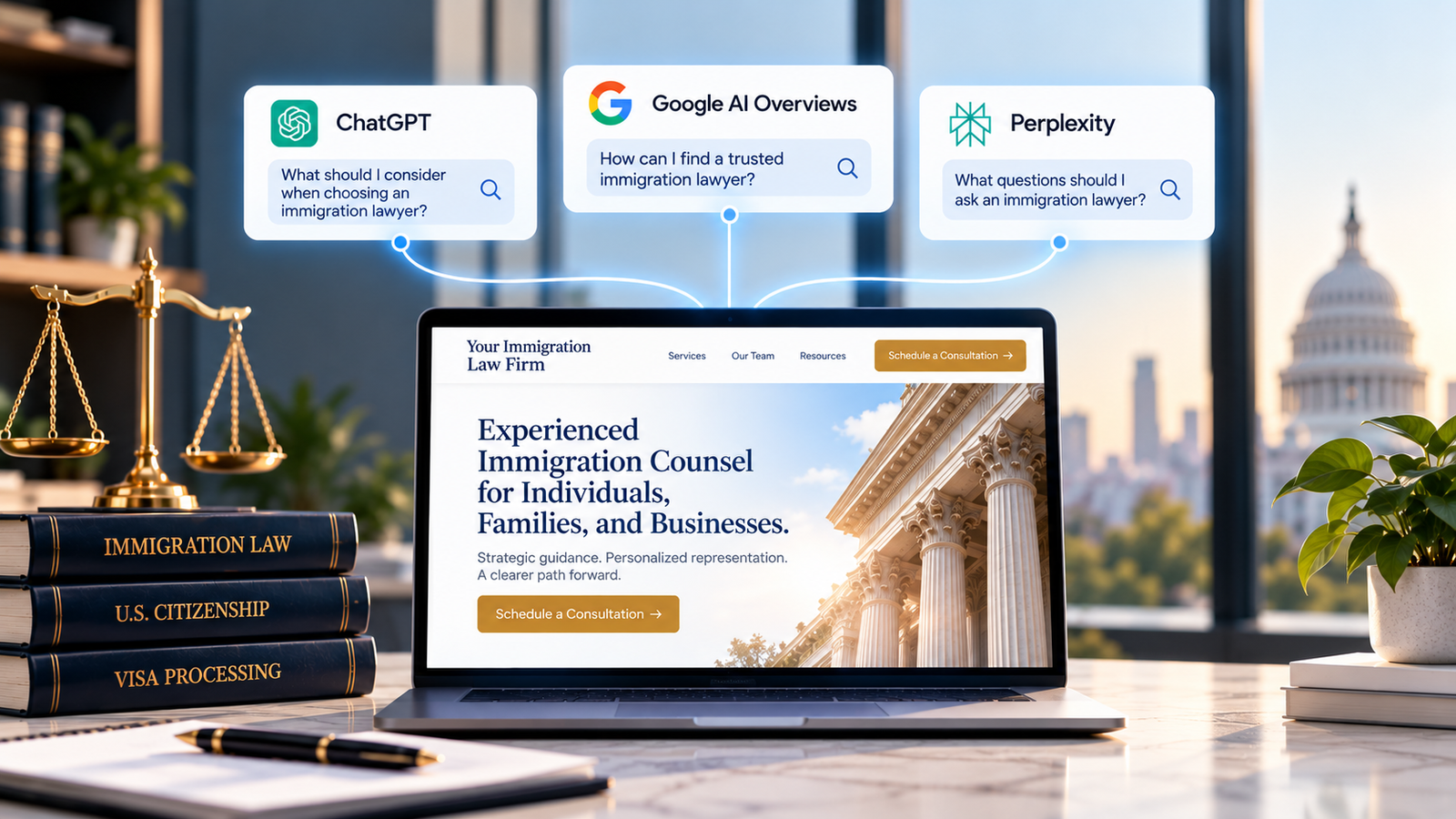
- What should I consider when choosing an immigration lawyer?
- What questions should an employer ask immigration counsel before sponsoring an H-1B?
- What information should I prepare before an immigration consultation?
- How do I compare law firms that handle removal defense?
A firm's website may help answer these questions, become a source for an AI-generated response, or offer a relevant next step. But appearing in an AI answer is not the business objective.
The objective is Qualified Visibility: being discoverable for searches that align with the firm's expertise, services, target clients, geographic reach, and growth priorities. A firm that attracts attention for irrelevant topics may gain visits without producing suitable consultations. A firm that becomes easier to discover for the right questions has a commercially meaningful opportunity.
How Do Law Firms Get Cited in AI Search Results?
There's no reliable formula for forcing an AI platform to cite a particular website. Firms can strengthen the foundations that make their content accessible, relevant, and useful. Start with five actions:
- Check technical access. Make sure important pages can be crawled and indexed by the platforms you care about.
- Answer real questions. Publish accurate, useful content that addresses the needs behind relevant searches.
- Demonstrate expertise. Use clear authorship, careful legal review, and trustworthy primary sources.
- Build a coherent website. Connect service pages, attorney biographies, and supporting resources with clear internal links.
- Measure business outcomes. Track search performance, AI referral activity, qualified inquiries, and consultations.
These are sound foundations, not a guarantee of inclusion.
Google AI Overviews and AI Mode
Google says its normal SEO best practices apply. To be eligible as a supporting link, a page must be indexed and eligible to appear in Search with a snippet, and Google says you don't need new machine-readable files, AI text files, or markup to appear in these features. Its documentation on AI features and your website also lists nosnippet, max-snippet, and noindex among the controls that limit what appears.
One detail many firms miss: Google points to your Googlebot rules and snippet controls for AI Overviews and AI Mode. It describes the separate Google-Extended setting as relating to AI training and grounding in some of Google's other systems, so blocking it is not how you leave AI Overviews.
ChatGPT search
OpenAI's crawler documentation separates OAI-SearchBot, which surfaces websites in ChatGPT search, from GPTBot, which crawls content that may be used to train its models. You can allow one and block the other. OpenAI says sites that opt out of OAI-SearchBot won't be shown in ChatGPT search answers, and that robots.txt changes can take about 24 hours to take effect.
Perplexity
Per its crawler documentation, Perplexity uses PerplexityBot to surface and link websites in its search results and does not use that crawler to train foundation models. A separate agent, Perplexity-User, fetches pages when a person asks a question. Some security tools block AI crawlers by default, so check your firewall and CDN rules as well as robots.txt.
The practical lesson: don't assume that allowing one crawler covers every platform. Check each platform's current documentation against your firm's actual configuration.
Why AI Search Is Different for Immigration Firms
Most AI visibility advice is written for any business. Immigration practice adds four complications that generic guides skip.
1. Rules change, and old pages don't announce they're old
Filing fees, form editions, processing practices, and program rules shift, sometimes quickly. A page that was accurate when it was published can become a liability later, and an AI tool may summarize it without the context that it's out of date.
Put visible "last reviewed" dates on legal content, link to primary government sources rather than restating details that change, and keep a review calendar for your highest-traffic pages. A content strategy for responding to immigration policy changes turns that review calendar into a routine.
2. Paragraphs get read on their own
AI answers often pull a specific passage rather than a whole page. Google says you don't need to chop content into fragments for AI, and I agree. But in immigration law, a sentence that's accurate only alongside the caveat in the next paragraph is risky.
Write important statements so they remain accurate when read on their own. Keep the qualification in the same sentence: "may," "in many cases," "depending on the facts."
3. Your clients don't all search in English
Many prospective immigration clients research in Spanish, Chinese, Hindi, Portuguese, and other languages. If your firm genuinely serves clients in another language, well-written pages in that language give search systems something relevant to work with. Write them with people who know the language and the law, not raw machine translation. If you don't offer service in a language, don't create pages that imply you do.
4. Advertising rules still apply when AI quotes you
ABA Model Rule 7.1 prohibits false or misleading communications about a lawyer's services, and each state has its own version. Claims that are already risky on your site, such as implied guaranteed outcomes or unqualified "specialist" language, become harder to control when an AI tool repeats them without context. Treat every page as if it might be quoted in pieces, because it might be.
My take. The firms I'd bet on in AI search aren't the ones publishing the most. They're the ones whose pages are still accurate when someone reads a single paragraph out of context.
The ILSE Qualified Visibility Framework
At Immigration Lawyer SEO Expert (ILSE), we evaluate visibility against the firm's commercial priorities, not in isolation. Our Qualified Visibility framework looks at six dimensions: Relevance, Intent, Market, Coverage, Trust, and Action.
| Dimension | Diagnostic question | Evidence to inspect | Priority action |
|---|---|---|---|
| Relevance | Does the website reflect the firm's actual expertise? | Service pages, practice descriptions, attorney information | Clarify the services the firm genuinely provides |
| Intent | Does the page address the visitor's real question? | Search queries, headings, page content, user actions | Match content to the searcher's need |
| Market | Is the firm visible in the markets it wants to serve? | Relevant search results, local pages, competitors | Address meaningful market and geographic gaps |
| Coverage | Does the site answer important questions across the client journey? | Content inventory, internal links, missing resources | Improve priority content gaps |
| Trust | Can readers evaluate the credibility of the information? | Authors, credentials, legal sources, review dates | Strengthen accuracy and verifiable expertise |
| Action | Can a suitable visitor take the next step? | Consultation pages, contact paths, intake data | Connect visibility to qualified inquiries |
This is ILSE's diagnostic model, not a description of how Google or any AI platform ranks pages.
Its value isn't just that it names six areas to inspect. It helps a firm decide which improvement deserves attention first.
How should a firm prioritize its findings?
An audit can produce dozens of recommendations. Doing all of them at once wastes time, hides what's working, and pulls resources away from the firm's real growth priorities. Use four questions:
- Does the issue affect a priority service or audience? A problem on the page for a service you want to grow matters more than a minor issue on an unrelated article.
- Is there evidence the problem exists? Check indexing reports, search queries, analytics, and intake data. Don't prescribe a fix just because it's on a generic checklist.
- Does the action address the diagnosed problem? If a crawler can't reach the page, rewriting its introduction won't help. If relevant visitors arrive but the offer is unclear, more articles won't help either.
- Can the outcome be evaluated? Set a baseline and decide what evidence would show progress. Technical fixes can usually be verified directly. Changes in consultations take longer and rarely trace back to a single change.
A practical starting order:
- Resolve technical barriers affecting important pages.
- Strengthen commercially important service pages.
- Address meaningful content gaps.
- Improve the path from relevant content to consultation.
- Expand only where evidence supports the investment.
This is a prioritization method, not a universal rule. A firm with strong technical foundations but poor inquiry quality may need to fix relevance and the path to a consultation before expanding content.
Relevance: make the firm's expertise clear
A website should explain what the firm does, whom it serves, and which matters it's equipped to handle. A homepage that says the firm handles "all immigration matters" communicates breadth without explaining capability.
Where accurate, give each priority practice area its own page: family-based petitions, employment-based visas, asylum, removal defense, naturalization. Each should describe the work, the intended clients, geographic scope, and how representation begins. Don't create pages for services the firm doesn't offer just because the keywords look attractive.
Intent: answer the question behind the search
A person researching a process may need general information. An HR director comparing immigration counsel wants to understand services, experience, and how engagement works. These visitors need different pages.
A service page should explain the service and who it's for. An educational article should answer its question directly and link to the relevant next step. A question in a heading is not a substitute for a useful answer under it.
Market: prioritize the right opportunities
A firm doesn't need to be visible for every immigration query. Priorities should reflect the services it wants to grow, the clients it can serve, its geographic reach, and the value of the matters involved.
For local firms, Google's AI features guidance lists up-to-date Business Profile information among the SEO best practices, so an accurate, complete profile belongs in your AI visibility work. Our Google Business Profile checklist for immigration attorneys covers the fields that matter, and our Local SEO work treats the profile and the website as one system.
Don't assume that a competitor with hundreds of articles has a better strategy, or that your firm needs to match that volume.
Coverage: build connected, useful content
A single article can't address every question a prospective client has. A coherent site connects core service pages with relevant resources, attorney information, and practical next steps. For example, an employer-focused service page might link to a resource on preparing for a first consultation about sponsorship.
Each resource should have a distinct job. Improve existing pages before creating new ones that repeat the same information. Google's spam policies target scaled content abuse, which is publishing many pages mainly to manipulate search results rather than to help people, and separate pages for every variation of a question can drift into that territory. More pages don't make a site more relevant.
Trust: make expertise verifiable
Immigration law is consequential. Incorrect information can create real confusion about eligibility, deadlines, and options. Help readers and search systems evaluate your content through:
- Accurate attorney biographies with bar admissions and relevant experience
- Clear authorship and named attorney review on legal content
- Links to primary sources for legal and procedural claims
- Clear separation between general information and individual legal advice
- Visible review and update dates
- Consistent firm name, address, services, and contact details everywhere they appear
Avoid guaranteed-outcome claims, overstated credentials, and outdated explanations presented as universally true. Trust comes from accuracy and responsible editorial practice, not from a polished design.
Action: connect visibility to the next step
A prospective client who discovers the firm should be able to understand what it offers and decide whether to reach out. Link educational content to the matching service page, explain how consultations work, and make contact options easy to find.
Then check whether the content contributes to qualified inquiries. Visibility is an intermediate outcome, not proof of business impact.
Worked Example: Turning an SEO Finding Into an Action Plan
Consider a hypothetical U.S. immigration firm that wants more employer clients for employment-based immigration work.
Its site has a broad homepage, a thin service page, and several general articles. The firm wants more suitable inquiries but hasn't established why its content underperforms. The wrong first move is to commission 20 new articles. The better move is to diagnose the problem.
| Illustrative finding | Recommended decision | Why |
|---|---|---|
| The service page doesn't clearly explain the firm's employer-focused services | Improve the service page first | The core commercial page should explain the offer |
| Important pages have indexing or access problems | Investigate technical causes | More content won't fix an access issue |
| Search queries reveal relevant questions the site doesn't answer | Create or improve a focused resource | The content fills a real information gap |
| Educational pages attract relevant visitors but offer no clear next step | Improve internal links and consultation paths | The site needs to connect information to services |
| Visits grow but inquiries are unsuitable | Review intent, service alignment, and intake qualification | More visits aren't necessarily better visits |
Now take one finding in detail. The employment-based service page is vague. It doesn't describe the services, the intended audience, or how to take the next step.
Before
"Our firm provides comprehensive immigration services to businesses and individuals. Contact us to learn more."
After (if accurate for the firm)
"Our employment-based immigration practice helps employers understand the options relevant to their workforce needs. Explore the services we provide, see what information is useful to bring to a first consultation, and contact our team to discuss whether we're a fit."
The revised version names the service area and the audience and gives a clear next step. It doesn't imply eligibility, promise an outcome, or claim services the firm may not offer. It also reads accurately if an AI tool quotes it on its own.
The team would then:
- Verify that the wording accurately reflects the firm's practice.
- Confirm the page is crawlable, indexable, and eligible for snippets.
- Connect it to relevant supporting resources.
- Record a baseline for search performance and qualified inquiries.
- Review the evidence after implementation before deciding what to improve next.
This is an illustrative editorial example, not a client case study or a claim of measured performance. The principle holds either way: fix the highest-impact constraint before adding more activity.
Technical SEO Checks That Support AI Search Visibility
Useful content can't make up for every technical problem. Review these foundations before investing heavily in more content.
Check crawling, indexing, and snippet eligibility
Use Google Search Console to investigate indexing issues on important pages. Review canonical tags, robots directives, redirects, server errors, and sitemap accuracy. A URL in your sitemap isn't guaranteed to be indexed.
Also check for nosnippet or very restrictive max-snippet settings on pages you want cited. Google lists these controls as ways to limit what appears in Search, so a leftover setting can work against you.
Review AI crawler access, including your CDN
Check your robots.txt rules and any hosting, CDN, or firewall settings. Some security configurations block AI crawlers without anyone at the firm deciding to. Here's a common configuration for a firm that wants to appear in AI search but opt out of OpenAI model training:
# Allow AI search crawlers to surface your pages
User-agent: OAI-SearchBot
Allow: /

User-agent: PerplexityBot
Allow: /

# Optional: opt out of OpenAI foundation-model training
User-agent: GPTBot
Disallow: /

# Google AI Overviews and AI Mode follow your Googlebot rules.
Whether to allow training crawlers is the firm's decision, and reasonable firms decide differently. Allowing a search crawler doesn't guarantee a citation. Blocking one limits discovery through that platform.
Make important content accessible
Use descriptive titles, clear headings, meaningful internal links, and content available as text. Information locked in images, PDFs, or scripts that don't render is harder for any system to use. Test important pages directly rather than trusting a generic checklist.
Use structured data accurately
Structured data can help search engines interpret a page when it's correct. Use supported types that match visible content, such as Attorney or LegalService and Person for attorney bios, and validate them.
Don't treat schema as a shortcut to AI citations. Google states plainly that you don't need special markup to appear in its AI features.
Skip the unsupported GEO shortcuts
Be skeptical of claims that firms must add llms.txt, rewrite every paragraph "for AI," create hundreds of thin question pages, or manufacture mentions across the web. Google says you don't need AI text files or special markup for its AI features, doesn't ask for content broken into tiny pieces, and cautions that seeking inauthentic mentions across the web isn't as helpful as it might seem.
My take. If someone is selling you an AI visibility package that starts with new files and new pages, ask what they found wrong with the pages you already have. It's the same question I'd ask when comparing a niche immigration SEO agency with a generalist.
For help assessing these foundations, see our Website & Content SEO services, which include technical fixes and AI answer engine visibility.
How Should Immigration Law Firms Measure AI Search Visibility?
No single metric captures the value of AI search. A useful reporting model separates visibility, referral activity, inquiry quality, and commercial outcomes.
| Measurement layer | What to track | Possible source | Decision it informs |
|---|---|---|---|
| Search visibility | Impressions, clicks, landing pages, indexing issues | Search Console Performance report | Which pages need technical or content work? |
| AI referral activity | Visits from ChatGPT, Perplexity, and similar referrers; landing pages; engagement | Web analytics referral reports | Is AI-referred traffic reaching useful pages? |
| Inquiry quality | Relevant inquiries and qualified consultations | CRM or intake records | Are visitors aligned with target services? |
| Commercial outcomes | Consultations, retained clients, revenue by practice area | CRM and firm reporting | Is marketing contributing to the firm's goals? |
Use the model for a monthly review:
- Identify pages or topics with meaningful changes.
- Decide whether technical, content, or market factors may explain them.
- Review referral activity and inquiry quality.
- Choose a small number of priority actions for the next month.
- Record each change and its result so future decisions improve.
What if the firm can't attribute an inquiry to AI search?
Don't force a conclusion the data can't support. Analytics capture some AI referrals but not every AI-assisted discovery. Someone may see your firm in an AI answer, then search your name days later or call directly.
Record what you can observe and be explicit about what you can't. Adding "How did you hear about us?" to intake helps, though self-reported answers are imperfect too. Manual citation checks are a snapshot, because AI answers vary by phrasing and context. Treat citations as a supporting indicator, not proof of consultations.
A 30-Day Action Plan for AI Search Visibility
Week 1: Establish the baseline
- Confirm priority services, target clients, and markets
- Record current search performance, AI referrals, and relevant inquiries
- Review important pages for technical issues
- Check robots.txt, CDN rules, and snippet settings
Output: a prioritized list of problems and opportunities.
Week 2: Improve core service pages
- Clarify priority practice-area descriptions
- Check access, indexing, and internal links
- Verify attorney information and legal claims
- Improve consultation paths
Output: stronger core pages aligned with business priorities.
Week 3: Address content gaps
- Review search queries and recurring intake questions
- Add review dates and primary sources to legal content
- Improve existing content before commissioning new pages
- Create new resources only when they serve a distinct purpose
Output: a focused content plan and initial updates.
Week 4: Measure and prioritize
- Recheck technical fixes
- Compare performance with the baseline
- Review AI referral data and qualified inquiries
- Record findings, limitations, and next actions
Output: a concise review and next month's priorities.
Thirty days is enough to set up a disciplined process and make the first improvements. It's not a promise of citations, ranking gains, or new clients in that period.
Make Your Immigration Law Firm's Expertise Discoverable
AI search is changing how people find and evaluate information. Effective visibility still depends on being relevant, useful, credible, and clear about what happens next.
For immigration firms, the opportunity isn't to appear in every AI answer. It's to become easier to discover when prospective clients research services the firm is genuinely equipped to provide. That takes more than a publishing quota or a list of AI tricks. It takes understanding the firm's priorities, the questions its clients ask, the gaps in its website, and the outcomes its marketing should support.
For the wider picture, see immigration law firm marketing trends in 2026.
Want to know which visibility gaps matter most on your site?
We'll look at your current visibility, the competitive landscape, and the clearest opportunities we see.
Frequently asked questions
Does a law firm need a separate website for AI search?
No. The starting point is the firm's existing website: technical SEO, content quality, and clear site structure. A separate AI-focused site isn't a requirement for appearing in AI search.
Does publishing more articles increase AI citations?
Not necessarily. New content helps when it answers a real question and adds value. Mass-producing pages mainly to influence AI responses risks running into Google's spam policies.
Is schema markup required for Google AI Overviews?
No. Google says you don't need special markup to appear in AI Overviews or AI Mode. Structured data is still worth using where it accurately describes visible content.
Should immigration lawyers block AI crawlers?
It depends on the crawler's purpose and the firm's preferences. Search crawlers like OAI-SearchBot and PerplexityBot affect whether you can appear in those platforms' answers. Training crawlers like GPTBot don't. Many firms allow search crawlers and decide separately about training.
Does blocking Google-Extended remove my site from AI Overviews?
No. Google points to your Googlebot rules and snippet controls for AI Overviews and AI Mode. Google-Extended relates to AI training and grounding in some of Google's other systems.
How long does it take to improve AI search visibility?
There's no reliable universal timeline. Results depend on technical condition, content quality, competition, implementation, and platform changes. Set a baseline and evaluate over time rather than relying on promised timelines.
Can a small immigration law firm compete with larger firms?
Often, yes, by focusing on the services, markets, and questions most relevant to its practice. Accurate content, credible expertise, clear service pages, and sound technical foundations improve the odds of discovery. Outcomes still depend on competition and factors outside the firm's control.
Should firms prioritize AI search or traditional SEO?
They're largely the same work. Google treats its AI features as an extension of Search, so its normal SEO best practices apply. Start with the foundations that support both, and treat AI search as part of the firm's broader acquisition strategy.
Yemi Oyedepo
Works with immigration law firms on AI search visibility, local SEO, and content. Has led local, bilingual, and content SEO programs for 30+ immigration firms nationwide, with an average 4.9-star client rating. See the full results. More about our team and approach →
Immigration Lawyer SEO Expert is a marketing consultancy and does not provide legal services or legal advice. This article is general marketing information. Platform documentation changes often. We last reviewed the platform sources cited here on October 29, 2026, and will review this guide again by April 2027.